0414-324 | International Business | Summer 2026 | Midterm
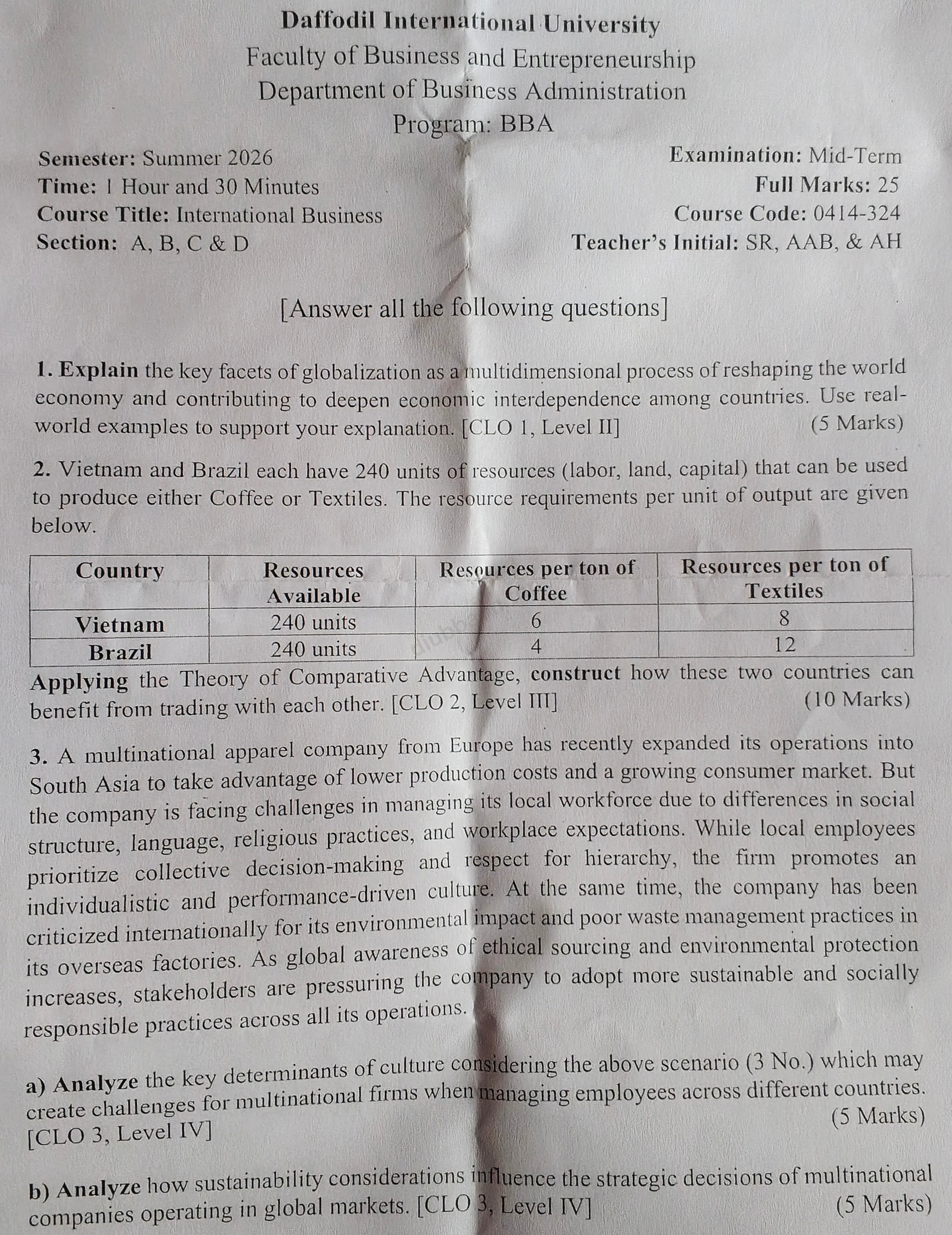
0414-324 | International Business | Summer 2026 | MidtermIntroductionMidterm exam for International Business covers globalization, comparative advantage, and cu...
0414-324 | International Business | Summer 2026 | Midterm
Introduction
Midterm exam for International Business covers globalization, comparative advantage, and cultural/sustainability challenges in MNCs. Solutions are concise, formula-based, and exam-focused.
This post provides model answers for all questions, aligned with CLOs and marking schemes.
Question Solutions
Q1: Key facets of globalization
- Economic: Trade liberalization (e.g., WTO) boosts cross-border trade (China’s export growth).
- Technological: Digital platforms (e.g., Amazon) enable global e-commerce.
- Political: Regional blocs (e.g., EU) reduce barriers, deepen interdependence.
- Cultural: Global brands (e.g., McDonald’s) adapt to local tastes (McAloo Tikki in India).
Q2: Comparative Advantage (Vietnam vs. Brazil)
- Calculate max output:
- Vietnam: Coffee = 240/6 = 40 tons, Textiles = 240/8 = 30 tons.
- Brazil: Coffee = 240/4 = 60 tons, Textiles = 240/12 = 20 tons.
- Opportunity cost:
- Vietnam: 1 Coffee = 8/6 = 1.33 Textiles; 1 Textile = 6/8 = 0.75 Coffee.
- Brazil: 1 Coffee = 12/4 = 3 Textiles; 1 Textile = 4/12 = 0.33 Coffee.
- Comparative advantage:
- Vietnam: Textiles (lower OC: 0.75 < 0.33).
- Brazil: Coffee (lower OC: 3 < 1.33).
- Trade benefit: Specialize → Vietnam produces 30 Textiles, Brazil 60 Coffee. Trade at 1 Coffee = 2 Textiles (e.g., Vietnam exports 15 Textiles for 7.5 Coffee).
Q3a: Key cultural determinants
- Social structure: Hierarchy (local) vs. flat orgs (MNC) → conflict in decision-making.
- Religion: Workplace rituals (e.g., prayer times) clash with performance metrics.
- Language: Miscommunication → inefficiencies in training/operations.
Q3b: Sustainability’s strategic impact
- Cost: Eco-friendly tech (e.g., solar-powered factories) raises short-term costs but cuts long-term risks.
- Reputation: Ethical sourcing (e.g., Fair Trade cotton) attracts ESG investors, avoids boycotts.
- Regulations: Compliance with EU/US green laws (e.g., carbon taxes) avoids fines.
Key Concepts
- Globalization: Multidimensional (economic, tech, political, cultural) integration.
- Comparative Advantage: Trade based on opportunity cost, not absolute efficiency.
- Cultural Determinants: Social structure, religion, language, values, education.
- Sustainability: ESG (Environmental, Social, Governance) drives MNC strategy.
FAQs
Q: How does comparative advantage differ from absolute advantage?
A: Comparative advantage focuses on opportunity cost; absolute advantage on production efficiency.
Q: Why do MNCs face cultural challenges?
A: Differences in values, communication, and workplace norms create friction.